
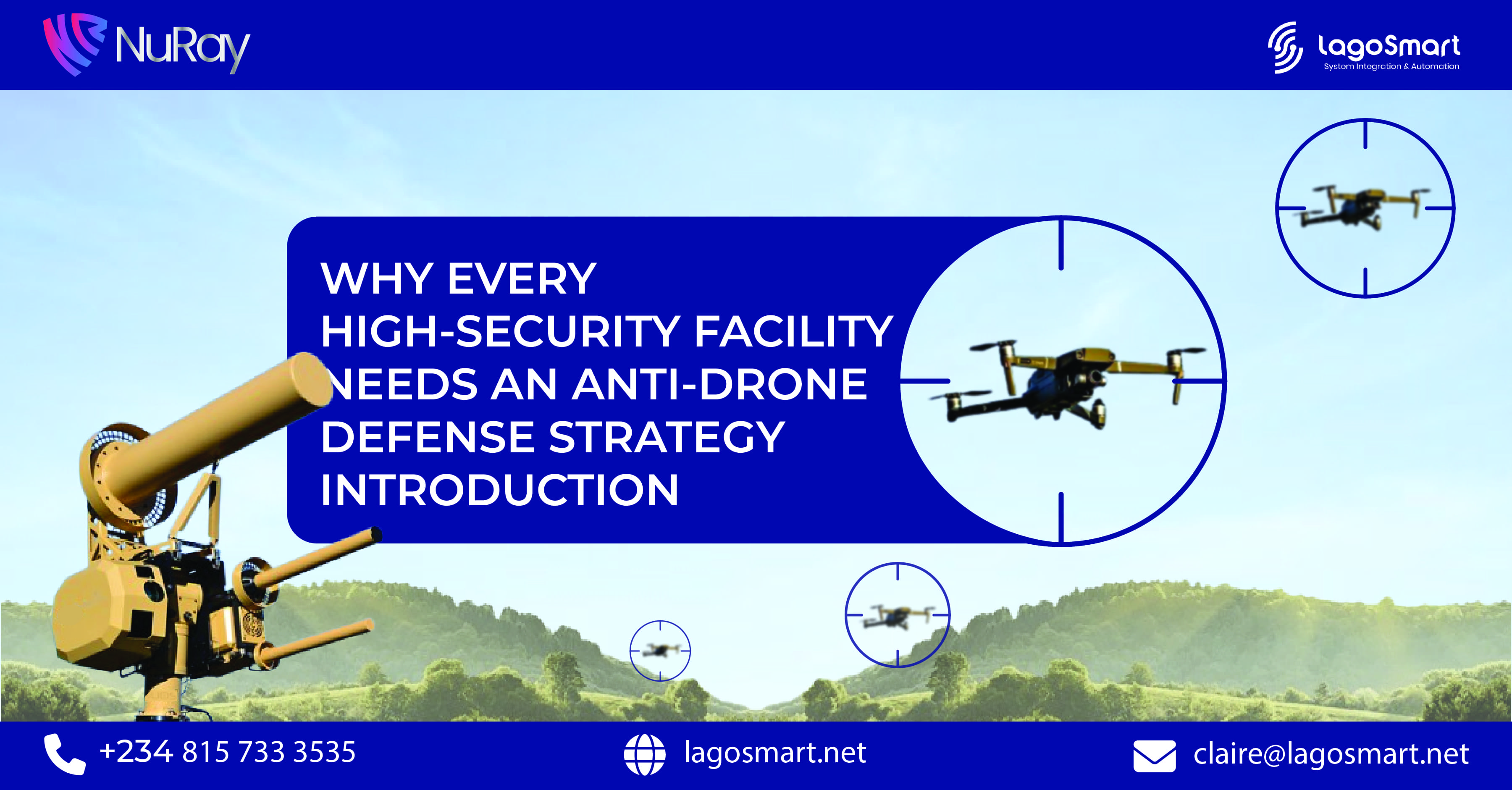
Why Every High-Security Facility Needs an Anti-Drone Defense Strategy
In the current security environment, threats no longer approach only from the ground. Drones, once the domain of hobbyists and filmmakers, are increasingly weaponized, capable of surveillance, smuggling contraband, or even carrying explosives. For high-security facilities, such as oil & gas plants, major manufacturing sites, and critical infrastructure, adopting an anti-drone defense is no longer optional; it’s essential.
In this article, we’ll explain the risks, how counter-drone systems work, and why lagoSmart Networks is positioned as a leader in deploying anti-drone solutions in Nigeria and beyond. If you manage or consult for a high-security site, this is a must-read.
The Rising Drone Threat to Critical Facilities
1. Weaponization & Malicious Use
Drones can now carry small payloads, making them potential delivery vehicles for bombs or harmful payloads. In conflict zones around the world, non-state actors have used drones to attack infrastructure. The risk is not hypothetical for high-security sites, it’s real.
2. Espionage & Data Exposure
Even without lethal intent, drones can collect images, capture video streams, or drop listening devices, exposing operations, site layouts, and vulnerabilities. For facilities handling sensitive processes or proprietary technology, this is a serious threat vector.
3. Operational Disruption
A rogue drone flight might trigger emergency shutdowns or force evacuation. In operational settings such as refineries or chemical plants, even minor interruptions can incur substantial costs.
4. Regulatory & Liability Risk
In Nigeria, the Nigeria Civil Aviation Authority (NCAA) has begun collaborating with the Office of the National Security Adviser (ONSA) to reinforce aviation security with anti-drone systems.
Facilities that fail to manage airspace risk, noncompliance, and liability in case of incidents.
How Anti-Drone Defense Works
A credible anti-drone solution uses a layered approach combining detection, classification, tracking, and mitigation. Leading systems (for example, those offered by companies like Dedrone) integrate radar, radio frequency (RF) sensors, cameras, and jammers.
Dedrone
Detection & classification: Identify a flying object, filter out benign drones, and classify threats
Tracking: Monitor trajectory and flight behavior
Mitigation/neutralization: Soft-kill (jamming communications, GPS spoofing) or hard-kill (in extreme cases)
Alerting & logging: Send real-time alarms, record data, and integrate with the security operations center
This layered, sensor-agnostic architecture is the benchmark for modern anti-drone defense.
Why High-Security Facilities Must Act Now
High-stakes environment: Facilities such as oil & gas terminals, petrochemical plants, large factories, power plants, critical infrastructure, airports, and stadiums are prime targets.
Scalability of threat: Drone threats don’t scale by manpower. A small drone entering an airspace can evade perimeter fences.
Rapid dynamics: Drone technology evolves fast. Sites that don’t deploy anti-drone capabilities risk being outmatched.
Reputation & safety: A drone incident can damage public trust, endanger lives, or trigger financial and legal backlash.
lagoSmart Networks: Leading Anti-Drone Deployment in Nigeria and Beyond
At lagoSmart Networks, we specialize in designing, installing, and managing anti-drone systems tailored to local environments. Here’s how we differentiate:
Local expertise, global standards
We integrate international best practices with Nigeria’s unique regulatory and operating conditions. Our solutions are compliant with the NCAA and airspace frameworks.
End-to-end delivery
From site survey to system installation, calibration, training, and ongoing support, we oversee every stage.
Proven track record
We serve clients in security-sensitive industries, having delivered resilient and adaptive installations in Nigeria and in neighboring markets.
Forward-looking innovation
We continuously monitor global advances (e.g., AI-based detection, machine learning threat modeling) to future-proof our installations.
By partnering with lagoSmart Networks, clients don’t just buy a product; they acquire a trusted defense partner committed to securing the skies above their operations.
If you oversee or consult for a facility that demands the highest level of security, don’t wait until a drone incident occurs. Book a consultation call with us today to assess your airspace vulnerabilities and design a tailored anti-drone defense plan.